Panama Bike is one of the new releases in Virtual Active’s
Bike Series 2 and it may easily become one of my favourite VA rides :) It’s led by Elliott
Bringman, who’s newto VA.I really enjoyed him as a trainer and this
ride seemed to fly by.
Length: 55 minutes
Format:Elliott calls
this a “foundation ride that’s great for beginners and experienced cyclists
alike”.He never really explains exactly
why it’s a foundation ride but I think it’s because it covers all the “basics”
(cadence changes, seated climbs,standing
climbs, pedal drills, etc) while not being super challenging. Like all VA
workouts, it’s divided into 5-minute stages. I like that there’s a bit of
everything in this workout, including a good deal of standing work, which is my
favourite. Even though there are some cadence changes, I would have liked some
real sprints. Here’s the profile:
Music: I liked the music in the Panama ride much more than
in Chilean Patagonia and Costa Rica. It’s a good mix of instrumental and
vocals—some pop, some hip hop, some rap. It’s very fun and upbeat.
Footage: the footage is varied and stunning. Each stage features different terrain, which
is something I love about VA workouts. Some of the locales visited are Panama
City, the famous Canal and locks, a rainforest and an island beach. I really
liked that this ride had two urban stages, which is something that’s been
lacking in Bike Series 2 so far.
Difficulty: as Elliott points out, the Panama ride is great
for beginners since it isn’t too difficult but it’s also great for more
experienced riders who don’t want to go all-out. The most challenging parts for
me were the seated climbs. 7/10 for difficulty.
Other Random Thoughts: there really isn’t anything about the Panama
ride that I didn’t like. Elliott is great, the scenery is gorgeous and varied,
the music is fun and the ride itself has a lot of variety. The only little
things that I would change would be to add in some sprints and maybe up the
challenge a bit. But overall, I loved this ride. 9/10.
Chilean Patagonia Bike is part of Virtual Active’s new Bike
Series 2. All the Bike Series 2 DVD’s feature one 55-minute ride and you have
the option of doing it guided or unguided. Chilean Patagonia is led by Caroline
Jordan (who also led the New Zealand ride in Bike Series 1), who I like a lot.
She has a calm voice and a good sense of humour—I love it when she talks to the guanacos (which are like alpacas) because that's something I would totally do.
Length: 55 minutes
Format: Caroline calls Chilean Patagonia an “endurance ride”. Caroline defines this as a "level of training where you don't work too hard or too easy" and says that most of a cyclist's training time should be dedicated to endurance rides as it builds your "aerobic base" and helps you "move oxygen more effectively to your muscles so that you can train at higher intensities more often". Your heart
rate is elevated and it stays relatively steady throughout an endurance ride. The profile of Chilean Patagonia is mostly
uphill—some of these hills you do seated and some you do standing. Chilean
Patagonia features a lot of “tempo rides". Tempo rides are when you’re working
at a pace that’sslightly uncomfortable
but one that you can sustain for a while. So you’re pushing hard but not going
all-out. Most of the ride has you in a moderate to high gear at a quick but not all-out speed. Like all 55-minute VA workouts, Chilean Patagonia is divided into 11 5-minute
stages and you always have the option of choosing to do the ride unguided.
Music: the music is all instrumental and it seemed to have
more of a driving beat than the music in the Costa Rica ride. Like the Costa
Rica ride, I didn’t notice the music a lot of the time but whenever I made a conscious effort to
pay attention to it, I liked what I heard.
Footage: Chilean Patagonia is stark but beautiful. The
scenery is what you would expect when you’re riding through the Andes—lots of
mountains, deserted dirt roads, lakes and rivers. My favourite footage features
in Stage 5, when you ride through a gorgeous valley.
As stunning as the footage
is, it sometimes feels repetitive. A great deal of your time is spent riding on
various deserted roads, mountains in the distance and a lake to your right or
left. So you see scenes like this a lot:
This isn’t necessarily a negative as it’s beautiful and it's the nature of the Patagonian
terrain. But if you prefer the scenery to change every stage as it does in most
VA workouts, then Chilean Patagonia may not be the best choice for you.
Difficulty: although Chilean Patagonia is challenging, I
didn’t find is quite as tough as the Costa Rica ride. This is most likely
because the 8 minutes of sprints that nearly killed me were missing. The
challenge inChilean Patagonia comes
from the fact that there is very little rest or recovery time and you’re
usually working in a moderate to hard gear. The drills I found to be the most
challenging is when you increase your gear but keep your cadence the same. And
then you increase your gear again but keep your cadence the same…and repeat. If
you follow Caroline’s instructions, Chilean Patagonia scores 8/10 for
difficulty.
Other Random Thoughts: as much as I really like Caroline and
see the value of endurance rides, I prefer rides with more variety. I missed
having intervals where you go all-out and I missed sprinting--although not for
8 minutes. (There are times in Chilean Patagonia where you increase your
cadence but not enough for me to consider them sprints). I also wish there was
more standing work. The repetitive scenery is another slight drawback—I think
Chilean Patagonia would work better as a 35-minute ride. But these are my
personal nitpicks. People looking to “build their base” and who don’t mind a
lof of the stages looking similar will love Chilean Patagonia. I don’t see
reaching for this one on a regular basis but I still got a great workout. 7.5/10.
I leave you with a scene from the cool down. Guanacos feature prominently in the ride :)
Virtual Active has released their Bike Series 2. The titles
in this series are Costa Rica, Argentine Patagonia, Chilean Patagonia, Panama
and Tierro del Fuego. Unlike their Bike Series 1 (which contained a 55 minute
ride and a 35 minute ride), the DVD’s in Bike Series 2 feature only one 55
minute ride (and, as always, you have the option of doing it guided or
unguided).
Yesterday I did the Costa Rica ride.It’s led by Buddy Mucuha (who led the British
Columbia ride in Bike Series 1), who I really like as a Virtual Active trainer—he’s calm and encouraging without seeming phony.
Length: 55 minutes
Format: like all the other Virtual Active rides, the Costa
Rica ride is divided into “stages". Each stage is around 5 minutes in length and
usually features a new geographical area (although sometimes a stage continues
in the same area as the previous one). Each stage usually features a particular skill to focus on. Some VA rides focus on speed or climbing but Costa Rica has a bit of
everything. One stage features a heavy hill climb, one stage features jumps,
another features sprints, etc. Buddy describes Costa Rica as an “advanced power
ride” and I’d agree. Like all VA rides, you always have the option of doing the
“unguided” workout if you want to ignore the format.
Here’s a screenshot of the profile to give you an idea of
what you face:
Music: the music is mostly instrumental and seemed to have a
suitably Latin flair. Once I got going and working hard, I really didn’t notice the music, which tells me it was neither terrible nor particularly memorable. I had to really pay attention to it in order to be able to comment on it here.
Footage: the Costa Rica ride takes you to various locales around
the country, including the Monteverde
Cloud Forest, La Paz Waterfall and Laguna Arenal. I love crossing the suspension
bridges in the cloud forest and at one point you cross (without a bridge) a
crocodile-infested river. During the final stage you ride along a beach at
sunset.
Difficulty: Buddy describes the Costa Rica ride as an
“advanced” ride and, as far as Virtual Active workouts go, I’d have to agree. It’s not as advanced as some of the Sufferfest
workouts but it is an advanced ride. (But remember: you can always do the
“unguided” ride and spin along to the scenery at your own pace).The toughest stages for me were the two back-to-back sprinting stages—8 minutes of 15 seconds on/15 seconds off. (And during the "off" intervals you're still pedalling at 80RPM.) 8/10 for difficulty.
Other Random Thoughts: I think Costa Rica may become one of
my favourite Virtual Active rides. It’s just a feel-good workout with beautiful
scenery, lots of variety, a perfect level of challenge and a fun trainer.
The only thing I didn’t love was the music, which didn’t add too much to the
ride. (There is a music-off option for the guided ride, so next time I may play
my own music while still having Buddy guide me). 8.5/10.
The Sufferfest has released a brand new workout :) It’s called The
Elements of Style and it isn’t your typical Sufferfest. Unlike other
Sufferfests, its end goal isn’t to break you down and destroy you. It aims to
increase your body awareness and efficiency while you’re on your bike. Not only does Grunter von Agony want you to suffer, he wants you to do it with style.
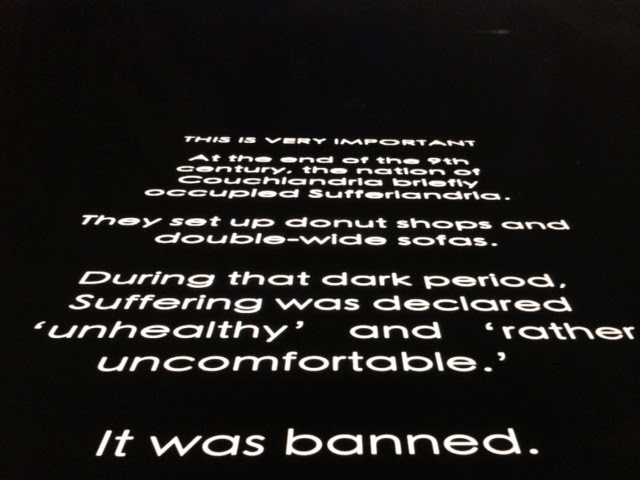
Bonus points for starting with a Star Wars-inspired crawl!
The Elements of Style is also unlike other Sufferfests in
that it’s narrated. The narrator is Carlton Kirby, a well-known cycling
commentator whose hypnotically smooth, deep, British voice made me feel like I
was watching a twisted nature documentary. (Which is a good thing.)
Length: 40 minutes
Format: The Elements of Style consists of 6 drills to “make
your suffering look effortless”. The drills are:
*systems
check
*pedal
stroke drills
*low
cadence drill
*high
cadence drill
*systems
check under pressure
*climbing
with your core
My favourite drills were the systems check (and systems
check under pressure) and the pedal stroke drills. The systems check is a
mental checklist to raise your body awareness and to ensure you know what “all
your bits and pieces are doing”. I found it surprisingly useful to pay
attention to what my ankles, knees, shoulders, were doing, as they aren’t body
parts usually associated with cycling. But they all play a role in your form
and, therefore, your efficiency. The “systems under pressure” drill takes you
through the same checklist but at a much higher cadence, since that’s usually
where your form falls apart.
The pedal stroke drill takes you through the four “segments”
of your stroke (the top, the down, the bottom and the up). First you focus only
on your right foot and only on the muscles that should be engaged on the top
stroke. You work your way through all the segments on your right foot before
moving to your left. I’ve been a road cyclist for ten years and a pretty
serious spinner for the last year but I had never paid much attention to the
different segments of my stroke and I enjoyed working through this drill.
Music: unlike in most Sufferfests, where the music is front
and centre, the music is really more in the background since Carlton speaks
through most of the workout. It’s mostly a mix of dance and electronica.
Footage: The Elements of Style was filmed in New Zealand and
the scenery is gorgeous.
Difficulty: this isn’t a beat-you-down-and-break-your-spirit-until-you’re-cursing-Grunter-von-Agony-type
Sufferfest but you still work hard. Physically, I’d give The Elements of Style
a 6/10. Even though there are sections where you’re pushing hard, the overall
length and lots of rest intervals make this one of the easier Sufferfests. However,
throw in the mental challenge of paying attention to your form and efficiency
and the challenge rises to 7/10.
Other Random Thoughts: I enjoyed The Elements of Style a
lot. I loved the scenery, the music and Carlton’s narration.The drills were valuable and they moved
quickly enough so as to not drag on and feel tedious. This is a fantastic
resource for new cyclists or spinners. Due to its nature it probably won’t find
it’s way into my regular rotation but I can see pulling it out every few weeks
for a “systems” check.Overall score:
8.5/10.
While spinning is my favourite way to keep fit, it certainly
isn’t all I do to stay healthy. I aim to spin 2-3 times a week
(although lately it’s been a pathetic once a week) and I do other types of
workouts on the other days. As much as I love spinning, if overdo it my knees
really feel it. So I mix it up. So here are some of my favourite non-spinning workouts:
Cardio: besides spinning, my favourite cardio to do is
kickboxing. My all-time favourite is Turbo Fire—it’s been a mainstay of my
fitness routine since it was released in 2010. It’s a Beachbody set
led by Chalene Johnson and features absolutely awesome music. It’s just fun fun
fun. I sweat like crazy and always feel great when I’m done. A word of warning:
some people find Chalene to be a bit over the top and some of the music to be
slightly objectionable. (I personally don’t but can see where those people are
coming from). It's also not strictly kickboxing--more like a kickboxing/dance fusion and the form isn't always perfect. Here's a clip:
My other favourite
kickboxing to do is the Powerstrike series, which is lead by Ilaria Montagnari.
Ilaria is the anti-Chalene: she’s very serious and form-driven. I don’t find
the Powerstrikes to be as much fun as Turbo Fire but I still love doing them
and get a great workout with Ilaria.
Strength-Training: my go-to for weights is Jari Love. Her
workouts are low weight/high reps, which is what my body responds to best. When I first started doing
weight-training about ten years ago, Jari was the first instructor I tried and
I’ve been loyal to her ever since. My favourites are still her original three
workouts (Get Ripped, Get Ripped: Slim & Lean and Get Ripped &
Chiseled), as some of her newer releases feature weird outfits and look like
they’re set in night clubs. When I want to do high weight/low reps, I turn to
Cathe Friedrich’s Burn Sets or Gym Style series.I’m also a fan of Chalene Johsnon’s Chalene Extreme (CLX)
and P90X/P90X3. I know that Tony Horton isn’t for everyone but I enjoy his
cheesy jokes :)
Ballet/Barre: these are newer categories for me, areas that
I’ve really only gotten into over the past year or so. For ballet, my absolute
favourite is Mary Helen Bowers’ Ballet Beautiful. These give me amazing lower body/butt
results and I aim to do her Classic Total Body workout at least 2x a week. I
also love Leah Sarago’s Ballet Body. She has tons of downloads and 4 DVD’s to
choose from—these are no joke and give me DOMS for days. For barre, my
favourite is Sadie Lincoln’s Barre3. The “3” is because they’re a mix of barre,
yoga and pilates.I also enjoy
Suzanne Bowen,The Bar Method and
Physique 57.
Essentrics: Essentrics is an off-shoot of Classical Stretch
(which I also love). Essentrics workouts are led by Sahra Esmonde-White and are
a bit hard to explain so this explanation is directly from their website: "Essentrics dynamically combines strengthening and stretching to develop a strong toned body with the complete ability of moving each joint and muscle freely and with full range of motion."
CS and
Essentrics are based in Montreal and they regularly work with and train the Canadiens and
Olympic athletes. Essentrics is wonderful for rehab and really
helped my recover from my back injury. I’m such a fan that I’m currently
undergoing teacher training to become an Essentrics instructor.
Here's a clip from one of my favourite Essentrics DVD's (Strength and Stretch in Motion:)
Kettlebells: before my injury kettlebells were a huge part of
my fitness routine. Sadly, I’ve had to abandon them because of my back injury
and I really miss them. I got fantastic results from an RKS rotation and hope
one day to be able to do it again. My other favourite KB workoutsare Paul Katami’s Kettlebell Drills and
AOS (Art of Strength), especially Providence and Santa Monica.
Pilates:I love pilates but have a hard time working it into
my rotation. I first started pilates with Jennifer Kries and she remains my
favourite pilates instructor, although some find her rather dry. At the
opposite end of the spectrum is Cassey Ho of Pop Pilates—her routines are fun
and high-energy. Jules Benson, Bernadette Girogi and Rebekah Rotstein are other instructors I enjoy.
Yoga:before my back injury I adored yoga and did it several times
a week. But about 15 months after my injury I started seeing an osteopath (who
I love and who deserves an entirely separate post) who told me that my body
“wasn’t made for yoga.” So I took a break from yoga and yes, sadly, my body
(especially my back) did feel better. But I really missed it. So kundalini yoga
has been a god-send. Kundalini is more spiritual and less physical than vinyasa
or power yoga (although it can be physically intense if you so choose).My favourites for kundalini yoga are a
husband and wife team, Ravi Singh and Ana Bret (better known as Raviana). I
also really like Mantra Girl. When I was doing vinyasa yoga, my favourite
practice was Tilak Pyle’s Altar of the Heart, which is a transcendent,
one-of-a-kind experience. I also loved Travis Eliot’s Ultimate Yogi set, Rudy
Mettia’s Yoga Warrior 365 set and anything by Eoin Finn.
Other instructors/sets that make it into my rotation on a
regular basis: Kelly Coffey-Meyer, Jessica Smith, Hamelin D'Abell, Jillian Michaels, Michael Olajide, Tracy
Anderson, Shaun T’s Insanity and Focus T25, Piyo, Leslie Sansone, Horizontal Conditioning, 21 Day Fix,
JNL Fusion, Dream Body, and You Are Your Own Gym.